
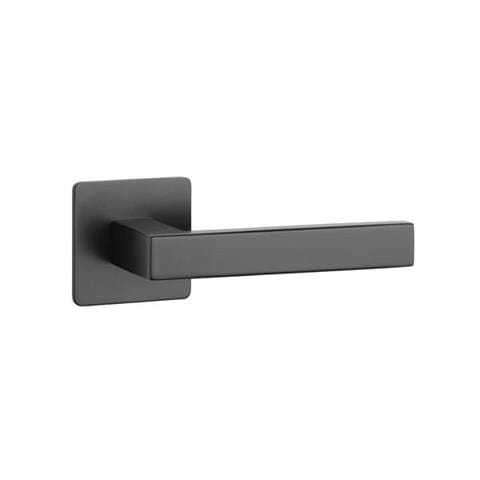
Fitting a door handle is a job you can do yourself in 10-15 minutes, with no special tools.
What you need
- A no. 2 Phillips screwdriver
- A 2.5 mm Allen key — usually included in the box
- A ruler or calliper
Step 1 — Remove the old handle
- Find the small screw on the rose (on the side or the inner face)
- Loosen it with the Allen key
- Pull the handle off the spindle
- Unscrew the rose (2 screws) and take it off
- Repeat on the other side and remove the square spindle
Step 2 — Check the dimensions
The new spindle should exceed the total thickness of the door by 5-8 mm. If it is too long, you can cut it with a hacksaw.
Step 3 — Fit the rose
- Set the rose into the groove in the door
- Fit the 2 screws — do not tighten fully, leave play for alignment
Step 4 — Insert the spindle and fit the handle
- Push the square spindle through the lock opening
- Slide the handle onto the spindle
- Press until it reaches the rose
- Tighten the Allen locking screw
Step 5 — The other side
- Fit the rose on the other side
- Slide the handle onto the spindle
- Align both handles so they are parallel
- Tighten the Allen screw and the rose screws on both sides
Final check
- The handle goes down and springs back to horizontal on its own? OK
- The latch goes in and out easily? OK
- The rose is firm, with no play? OK
Common mistakes to avoid
- Overtightening the Allen screw can jam the handle
- A spindle that is too short keeps the handle from engaging the mechanism properly
- Forgetting to align the handles before the final tightening
Technical questions? Contact us — the LC Design team answers quickly.
Tools and materials needed
You need: PH2 Phillips and flat-head screwdrivers (some Enger handles use Torx screws — check the box); a metal ruler to measure the axis distance and alignment; a pencil and an 8 mm wood drill bit (only needed for a new door without holes). Check the contents of the box: 2 handles, front and back roses, spindle, long fixing bolts, rose screws.
Preparation — what to check before you start
Check compatibility: the PZ axis distance must be the standard 72 mm; the locking type must match the lock (OB without cylinder, PZ with key, WC for bathrooms with a thumb-turn, BB with an inside button); door thickness — the standard 80 mm spindle included suits doors up to 45 mm; rotating handles on roses are universal left/right.
Fitting the rose and the cylinder
Step 1 — Remove the old handle: find the fixing screws (visible, or hidden under a decorative cap on the rose). Undo the long bolts that pass through the door, then pull the handles off. Step 2 — Remove the old cylinder: undo the fixing screw in the lock faceplate (visible on the edge of the door). Insert the key and turn about 30 degrees to extract the cylinder. Step 3 — Insert the new cylinder: with the cam slot aligned to the housing in the lock. Secure it with the faceplate screw. Do not overtighten — the cylinder must turn freely. Step 4 — Position the front rose: aligning its holes with the existing ones. A SLIM rose sits directly on the door surface, without spacers.
Fitting the handle
Step 5 — Push the spindle through the door: the 8 mm square spindle passes through the central hole of the lock. Orient it correctly — some spindles have a locking recess on one face only. Step 6 — Fit the front handle: slide it onto the spindle, align the fixing holes with the rose, insert the long bolts but do not tighten fully. Step 7 — Fit the back rose and handle: on the other side of the door, fit the rear rose, then the handle; align and insert the fixing bolts. Step 8 — Tighten the screws gradually: alternating front and back, a little at a time, so the rose stays flat on the door. Do not force — SLIM roses are zinc or aluminium and can crack if overtightened.
Adjustment and final check
- Test that the handle turns freely and springs back (the internal spring works)
- Check that the latch extends and retracts fully when you work the handle
- Test that the key works correctly in the cylinder from both sides
- Check that the rose sits flat on the door with no play or grinding
- Test with the door closed — the latch enters the strike plate without rubbing
Common problems and solutions
| Problem | Likely cause | Solution |
|---|---|---|
| The handle turns but the latch does not move | Spindle too short or wrongly positioned | Check the spindle length and its alignment with the lock cam |
| The rose does not sit flat, it has play | Screws too long or holes misaligned | Use the screws from the original set; realign the holes |
| The handle does not spring back | The internal spring is jammed or the spindle is bent | Take it apart and check the spindle is straight and the spring free |
| The key does not go in easily | The cylinder is not aligned with the lock cam | Loosen the cylinder fixing screw, align and refix |
| Noise when turning | The spindle rubs against the hole in the door | Lubricate with PTFE spray (not oil — it attracts dust) |
Hit a problem not listed here?
Contact us with a photo — we will help you find the right solution.