
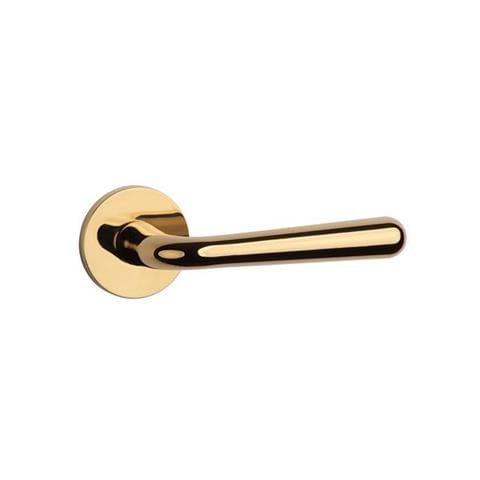
A handle fixed with through-bolts stays firm for the entire life of the door.
Find out why the choice of fixing method matters as much as the design of the handle —
especially on rebated doors, where a single wood screw may bite into just 5 mm of material.
What through-bolts are
There are two main ways to fix a handle to a door: wood screws (which bite into the door from one side only) and through-bolts (which pass right through the door and are locked on the other side with a nut or threaded insert).
Wood screws work exactly like on a cupboard or shelf: they enter the material, the thread cuts the wood fibres and holds by friction. The problem shows over time — wood moves, expanding and contracting with the seasons, opening-closing cycles apply repeated forces, and the thread in the wood tires and gradually gives way.
Wood screws
Bite from one side only, into the thickness of the door. Strength limited by the quality of the wood and the depth available.
Simple fixing
Through-bolts
Pass right through the door. Locked with a nut on the other side — incomparably higher pull-out strength.
Permanent fixing
The rebated-door problem — the critical 5 mm zone
Modern interior doors are made with a rebate — a raised step on the door leaf that overlaps the frame for sealing and sound insulation. This construction detail creates a specific problem when fixing handles with wood screws.
In practice: if the door has a 12 mm rebate and a total thickness of 40 mm, on one side the handle is fixed normally into 28 mm of material, while on the other the screw bites into just 8-10 mm. That is the side that fails first.
The symptoms are progressive: first the handle develops slight play, then the fixing gets looser and looser, until the roses visibly move and finally the handle can be torn off with a firm press — damaging the door surface around the hole as well.
Imperceptible initial play
For the first months the handle seems firm. The thread in the wood is starting to tire, but nothing shows.
The rose moves slightly
When pressed or twisted, the rose has 1-2 mm of play. The screws no longer grip the wood firmly.
Detachment and door damage
The rose comes off, tearing out MDF splinters or lacquer from the door. Repair is costly, or impossible without repainting.
Why a through-bolted handle never comes loose
The through-bolt works on the principle of a complete mechanical joint: a bolt passes through the door from one face to the other, and the nut (or threaded insert) on the far side creates a clamp that holds the rose firmly against the door surface.
| Criterion | Wood screws | Through-bolts |
|---|---|---|
| Pull-out strength | 200-400 N (depends on the wood) | 1,500-3,000 N (limited by the door material) |
| Behaviour over time | Loosens with every cycle | Stays constant — the nut does not tire |
| Risk on rebated doors | High — minimal grip on one side | Zero — both roses are locked mechanically |
| Hollow-core door compatibility | Limited — few fibres to grip | Excellent — the bolt passes through regardless of the core |
| Repairability | Difficult — the hole is damaged | Easy — replace the bolt and nut |
Which door types benefit most
Through-bolts are superior in any situation, but on some door types the difference is critical:
Rebated doors
The most common problem case. The rebate drastically reduces the depth available for wood screws on one face.
Very high risk without through-bolts
MDF doors
MDF fibres are less cohesive than solid wood. Wood screws loosen faster — within 2-3 years of intensive use.
High risk without through-bolts
Hollow-core (honeycomb) doors
The honeycomb core offers minimal support for screws. Without through-bolts, the fixing is precarious from day one.
Through-bolts are a must
How to fit a through-bolted handle correctly
Fitting is simple and needs no special tools — every Enger set includes everything required.
Measure the door thickness
Standard thicknesses are 35, 40 and 45 mm. Order the through-bolt set for the right thickness — the bolt should be 5-8 mm longer than the door is thick.
Mark and drill
Use the template included in the box. Drill with an 8 mm bit at exactly the indicated distance (rose centres, usually 72 mm).
Insert the spindle and the bolts
Fit the lower rose, insert the drive spindle, pass the bolts through the holes from the inside out.
Tighten the nuts and fit the outer rose
Tighten the nuts until the rose is firm on the door — without forcing. Fit the outer rose that covers the mechanism. Nothing looks different from a classic handle.
Enger handles and the through-bolt system
All Enger handles from the Aprile, Stile and Sterk brands are available with through-bolt fixing. The set includes stainless steel bolts, threaded brass inserts and roses with calibrated holes — all pre-set for quick fitting.
A classic line with square or round roses. Through-bolts come as standard in all finishes.
A modern slim line. The thin 5 mm rose makes through-fixing even more elegant — the bolt stays fully hidden.
If you are not sure of your door thickness or which through-bolt set fits, the LC Design team can guide you — we are the official Enger distributor in Romania and we know how to adapt the solution to every case.
Choose permanent fixing
Enger handles with through-bolts — fitted once, for the life of the door.